Abstract
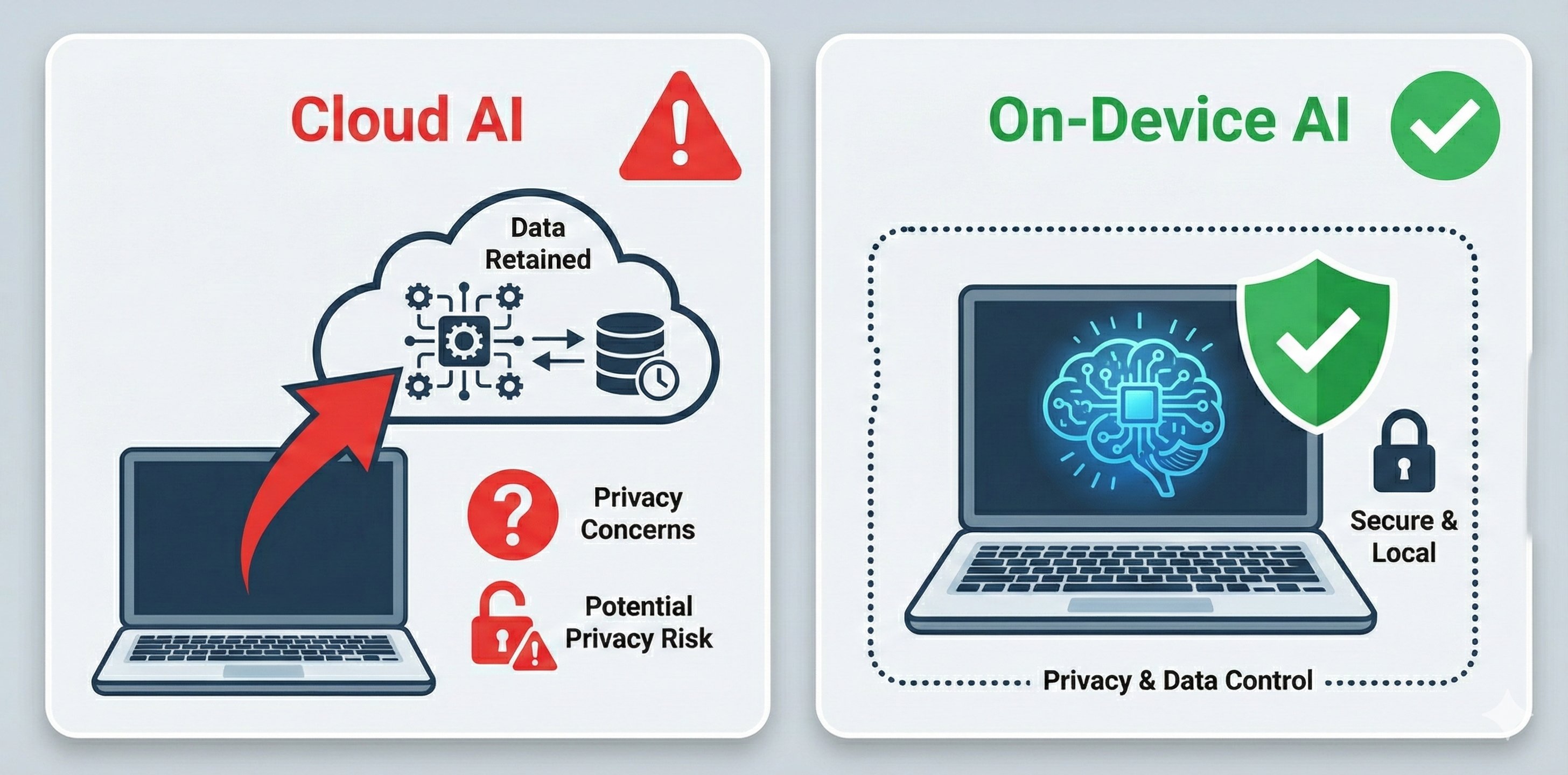
The current AI landscape assumes cloud processing: user data goes to API, inference runs on cloud GPUs, results return to user, provider stores/processes your data. This model has been accepted because "that's how AI works." But Apple Silicon and the MLX framework have changed the equation. For personal, sensitive applications, on-device LLM provides privacy by architecture rather than policy—your data physically cannot leave your device.
1. The Privacy Paradox
Every AI privacy policy says some version of:
"We don't use your data to train models... except for improving our services... and we may share with partners... and data is retained for..."
Privacy by Policy
- Trust a company's promise
- Policies can change
- Data breaches possible
- Requires faith
Privacy by Architecture
- Data cannot leave device
- Technically enforced
- No external exposure
- Verifiable
2. What Changed: Apple Silicon + MLX
For years, on-device LLM was impractical. Consumer hardware couldn't run meaningful models at usable speeds. Apple Silicon changed this:
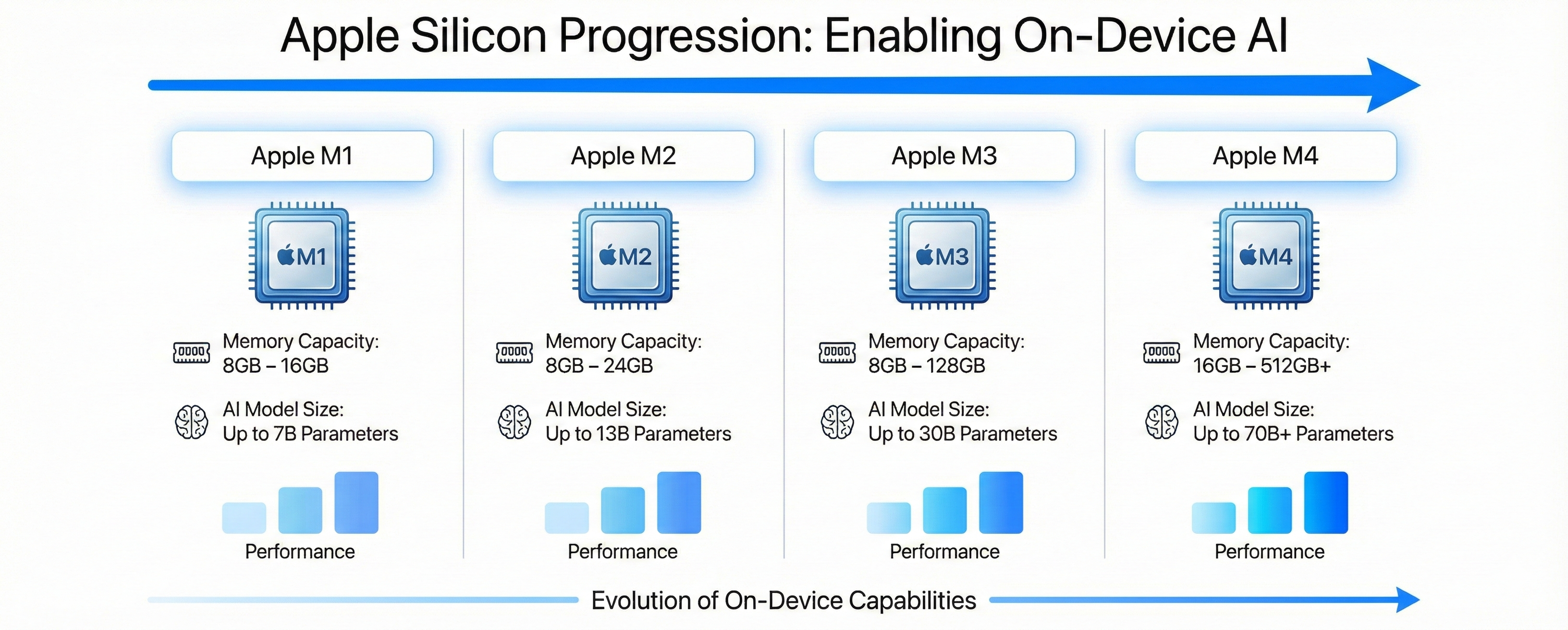
| Chip | Unified Memory | Memory Bandwidth | LLM Performance |
|---|---|---|---|
| M3 | 8-128GB (Ultra) | 100-800 GB/s | 25-115 t/s depending on tier |
| M4 | 16-128GB (Max) | 120-546 GB/s | 30-45 t/s on 33-70B models |
| M5 | 16-192GB | 153+ GB/s | 19-27% faster than M4 |
Note: Memory bandwidth matters more than chip generation for LLM inference. An M3 Max (400 GB/s) outperforms an M4 Pro for token generation.
Apple's MLX Framework
Apple's MLX framework optimizes specifically for this hardware: native Metal GPU acceleration, unified memory eliminates CPU/GPU transfer, quantized models fit in available RAM, and performance rivals cloud inference for many tasks.
3. Performance Reality Check
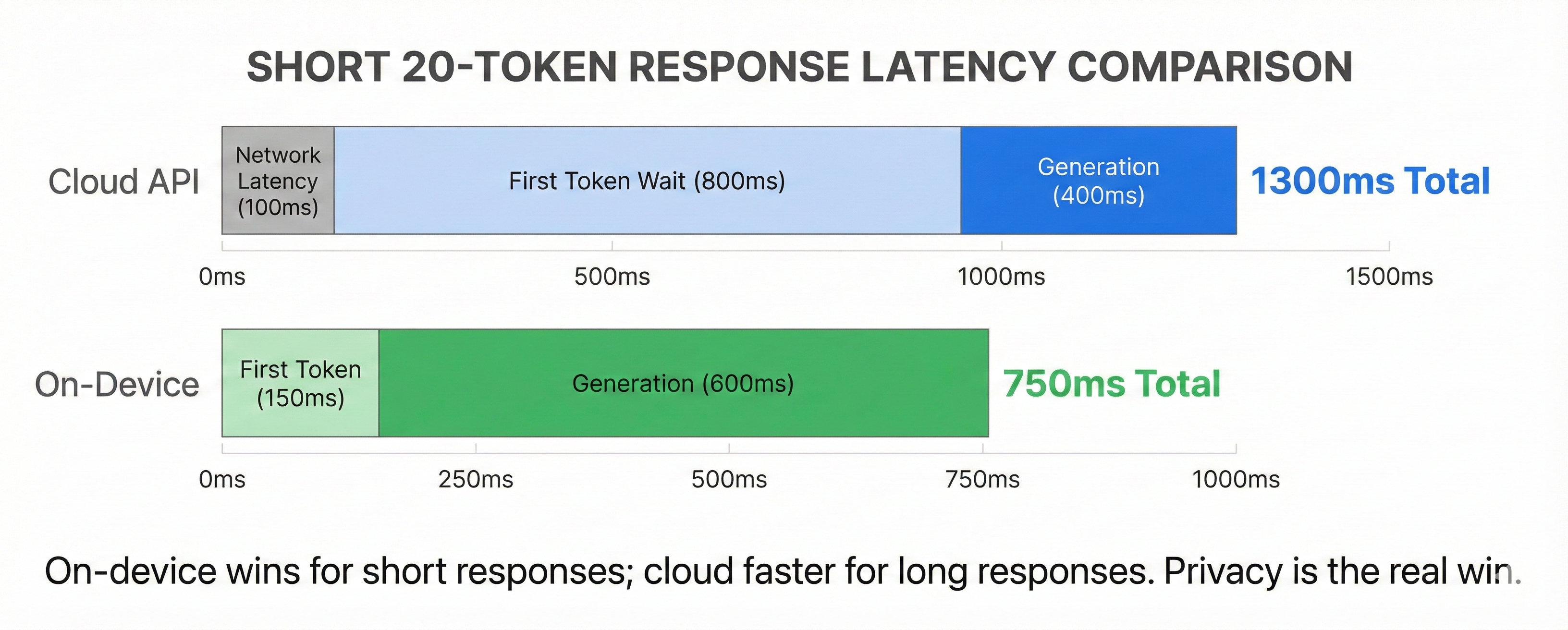
| Metric | On-Device (M3 Pro, Llama 8B) | Cloud API (Claude/GPT-4o) |
|---|---|---|
| First token | 100-200ms | 200ms-2s (varies by load) |
| Tokens/second | 25-50 | 30-80 |
| 100-token response | 2-4 seconds | 1.5-3 seconds |
On-device is competitive for shorter responses. The lack of network round-trip helps, but cloud models are often faster at raw token generation. The win for on-device is privacy, not speed.
4. The Cost Equation
| Cost Type | Cloud API (GPT-4 Turbo) | On-Device |
|---|---|---|
| Per-query cost | ~$0.015 (500 tokens) | ~$0.0001 (electricity) |
| 100 queries/day | $45/month | ~$0.30/month |
| Hardware | N/A | Already owned (Mac) |
For users who already own compatible hardware, on-device running costs are dramatically lower than API fees. The comparison assumes you're not buying a Mac specifically for this purpose.
5. What On-Device Enables
True Privacy
Conversations never leave your Mac. No data retention policies to parse.
Offline Operation
Works on airplanes, in poor connectivity. Always available.
No Subscriptions
One-time hardware investment. No per-token fees or rate limits.
Data Sovereignty
You own your data completely. Export anytime. Delete means delete.
6. Use Cases That Demand On-Device
Personal Knowledge Management
- Notes, journals, private thoughts
- Health information
- Financial data
- Family information
Professional Confidentiality
- Legal documents
- Medical records
- Business strategy
- Competitive intelligence
Sensitive Personal Tasks
- Therapy/mental health journaling
- Relationship advice
- Career planning
- Personal struggles
Would you send your private journal to a cloud API? On-device removes the question.
7. The Hybrid Approach
On-device doesn't mean cloud-never. A smart architecture uses both:
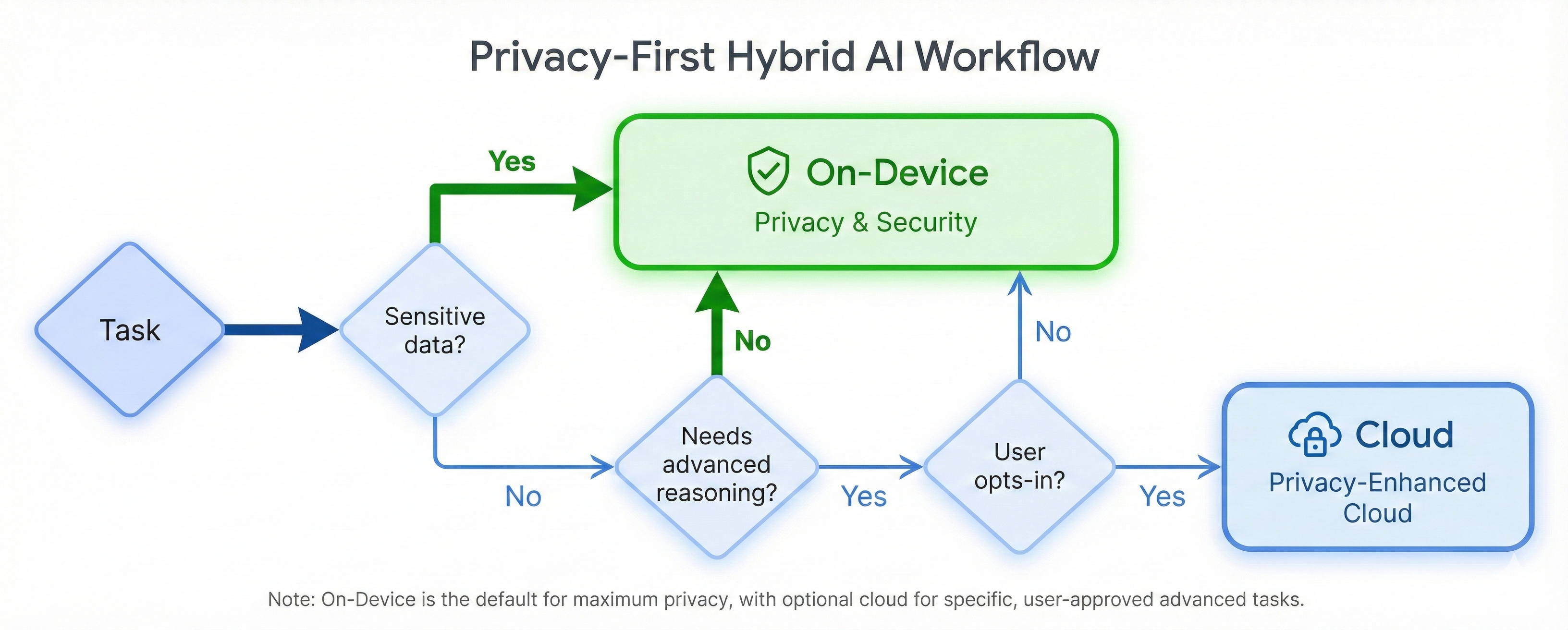
| Task | Processing | Reasoning |
|---|---|---|
| Private data analysis | On-device | Sensitive |
| Personal knowledge queries | On-device | Personal context |
| Complex reasoning | Cloud (opt-in) | User chooses |
| Public information | Cloud | No privacy concern |
User controls when data leaves device. Default is local.
8. Limitations and Trade-offs
Current Limitations
- Maximum model size bounded by RAM
- Not competitive with GPT-4/Claude for complex reasoning
- Less capable at specialized tasks
- Requires modern Apple hardware
What On-Device Does Well
- Summarization
- Entity extraction
- Simple Q&A
- Text classification
- Personal context understanding
9. Conclusion
On-device LLM isn't about avoiding cloud AI. It's about choosing when your data leaves your device.
For personal, sensitive, private use cases, the answer should be: never.
The technology now exists to make that practical.
References
- MLX — Apple's machine learning framework for Apple Silicon
- Apple Silicon GPU Architecture — Apple developer documentation
- Llama — Meta's open-source LLM models
Want to know more about on-device LLM? Contact me, I'm always happy to chat!