Abstract
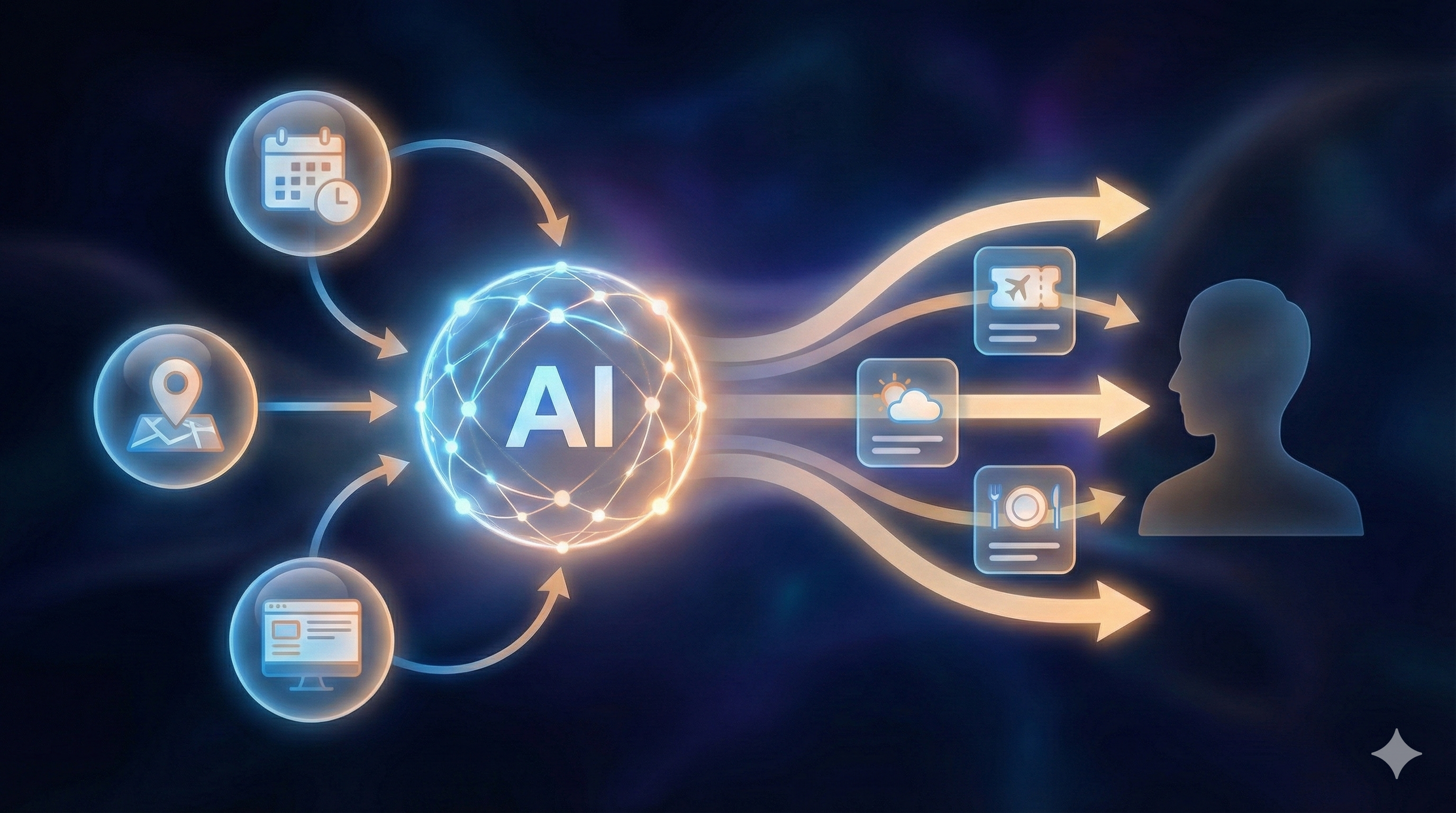
Every AI assistant today works reactively: user asks question, AI processes, AI responds. But the most valuable information is often what you didn't know you needed. Proactive AI monitors context—calendar, screen, location—and surfaces relevant information before users ask. This paper presents an architecture for anticipatory AI that feels intelligent rather than merely responsive.
1. The Reactive AI Problem
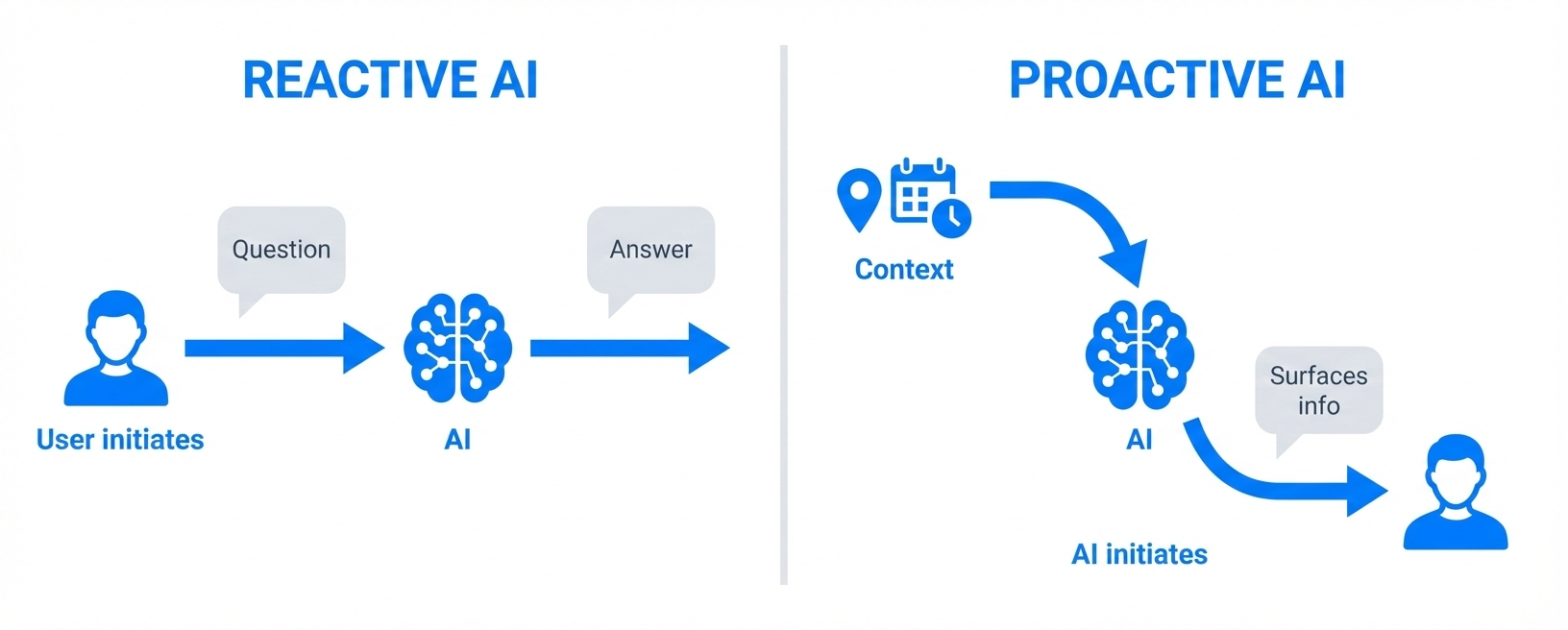
Every AI assistant today works the same way:
- User asks question
- AI processes
- AI responds
This is fundamentally reactive. The AI waits for you to know what to ask.
But the most valuable information is often what you didn't know you needed.
Reactive AI
User initiates:
"Hey Siri, what's on my calendar today?"
AI responds:
"You have a meeting with John at 2pm."
Proactive AI
[No prompt required]
"You're meeting John at 2pm. Last time you discussed the Henderson project. He mentioned concerns about timeline. Here's what you promised to follow up on."
The AI anticipates the question and surfaces relevant context before you ask.
2. Context Triggers
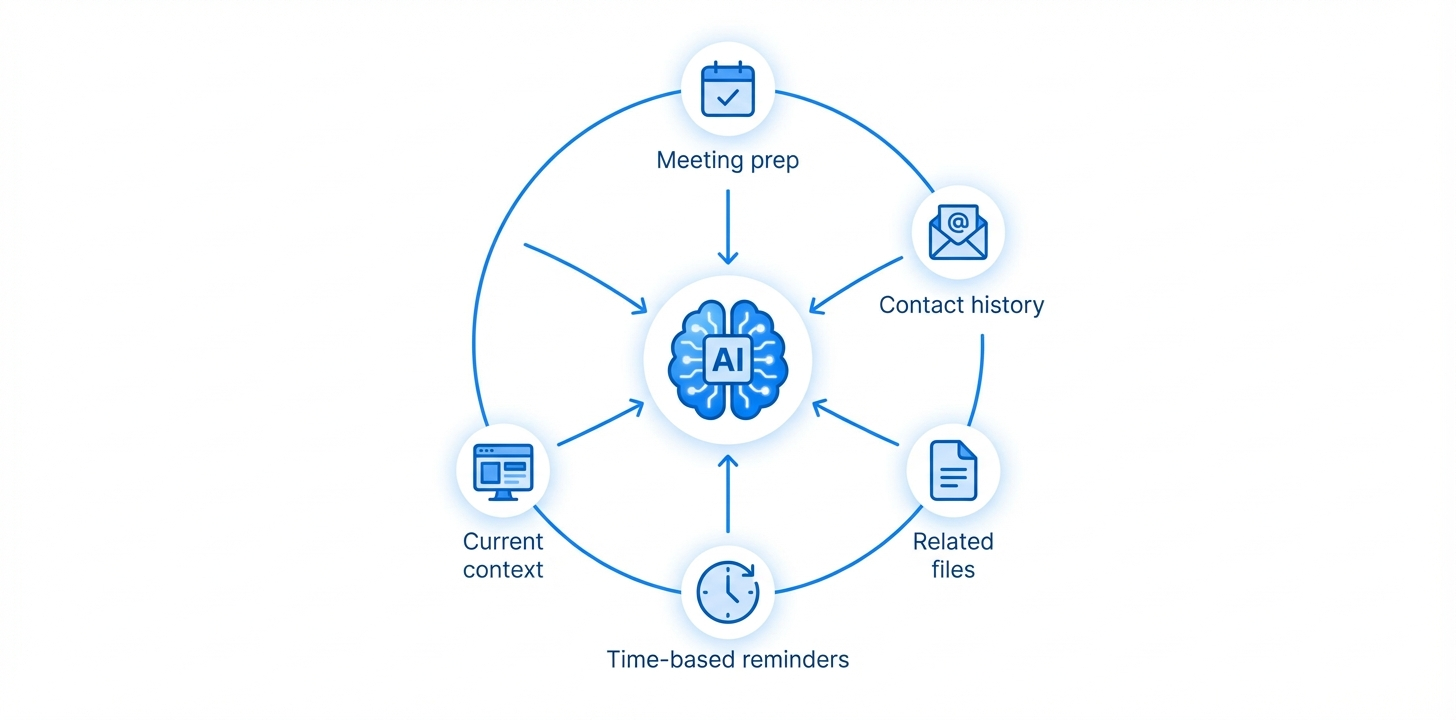
Proactive surfacing is triggered by context changes:
| Trigger | What to Surface |
|---|---|
| Calendar event approaching | Related facts, previous interactions, commitments made |
| Email from contact | Relationship history, pending items, shared context |
| Document opened | Related documents, previous versions, collaborator notes |
| Location change | Location-relevant information, nearby contacts |
| Time-based | Daily review, upcoming deadlines, expiring commitments |
| Screen content | Information related to what you're currently viewing |
3. The Meeting Prep Example
Traditional Workflow
- See meeting on calendar
- Wonder what it's about
- Search email for context
- Search notes for background
- Try to remember what was discussed last time
- Go into meeting unprepared anyway
Proactive Workflow
- 15 minutes before meeting, notification appears
- "Meeting with John (Henderson Project)"
- Summary of last interaction
- Commitments you made ("send updated timeline")
- His recent concerns (from your notes)
- Documents you both referenced
The Key Insight
No search. No recall effort. Context is ready. The AI knew what you'd need because it understood the relationship between calendar events, contacts, and your knowledge base.
4. The Commitment Tracker
People make commitments constantly:
- "I'll send that by Friday"
- "Let me follow up on that"
- "I'll think about it and get back to you"
Most are forgotten. A proactive system:
- Detects commitment language in conversations
- Extracts deadline (explicit or implied)
- Tracks status (pending, completed, overdue)
- Surfaces at relevant moments
Proactive Notification
"You told Sarah you'd send the proposal by Friday. It's Thursday and you haven't sent it."
5. The Knowledge Graph Foundation
Proactive surfacing requires understanding relationships:
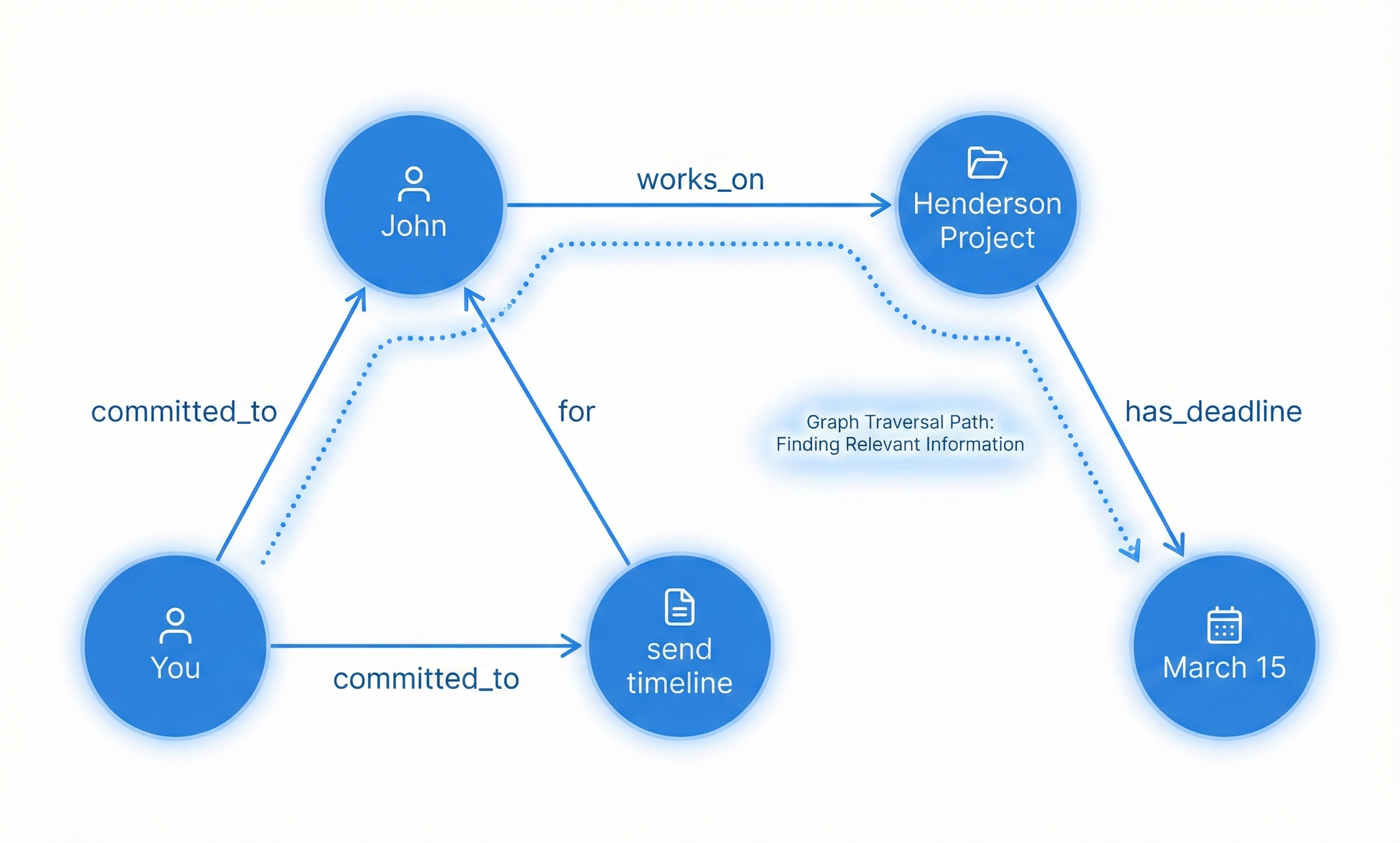
When you have a meeting with John, the graph traversal finds:
- John → works_on → Henderson Project → has_deadline → March 15
- John → mentioned_concern → "timeline slipping"
- You → committed_to → John → "send updated timeline"
6. Privacy Implications
Proactive AI requires deep context awareness:
- Screen content
- Calendar
- Email/messages
- Documents
- Location
This is precisely why on-device processing matters:
All Analysis Local
Processing happens on your device, not in the cloud
No Screen Content Transmitted
What you're viewing stays on your machine
No Email Content Sent
Your communications remain private
Context Stays Private
Your knowledge graph never leaves your device
Proactive AI without privacy guarantees is surveillance. With on-device, it's assistance.
7. The Interruption Balance
Proactive doesn't mean intrusive. Design principles:
Do Surface:
- Information with clear relevance to current context
- Time-sensitive items (deadlines, meetings)
- High-importance facts at appropriate moments
Don't Surface:
- Low-relevance associations
- Information you've recently seen
- Trivial facts unless specifically relevant
- Anything during focus time
8. Implementation Architecture
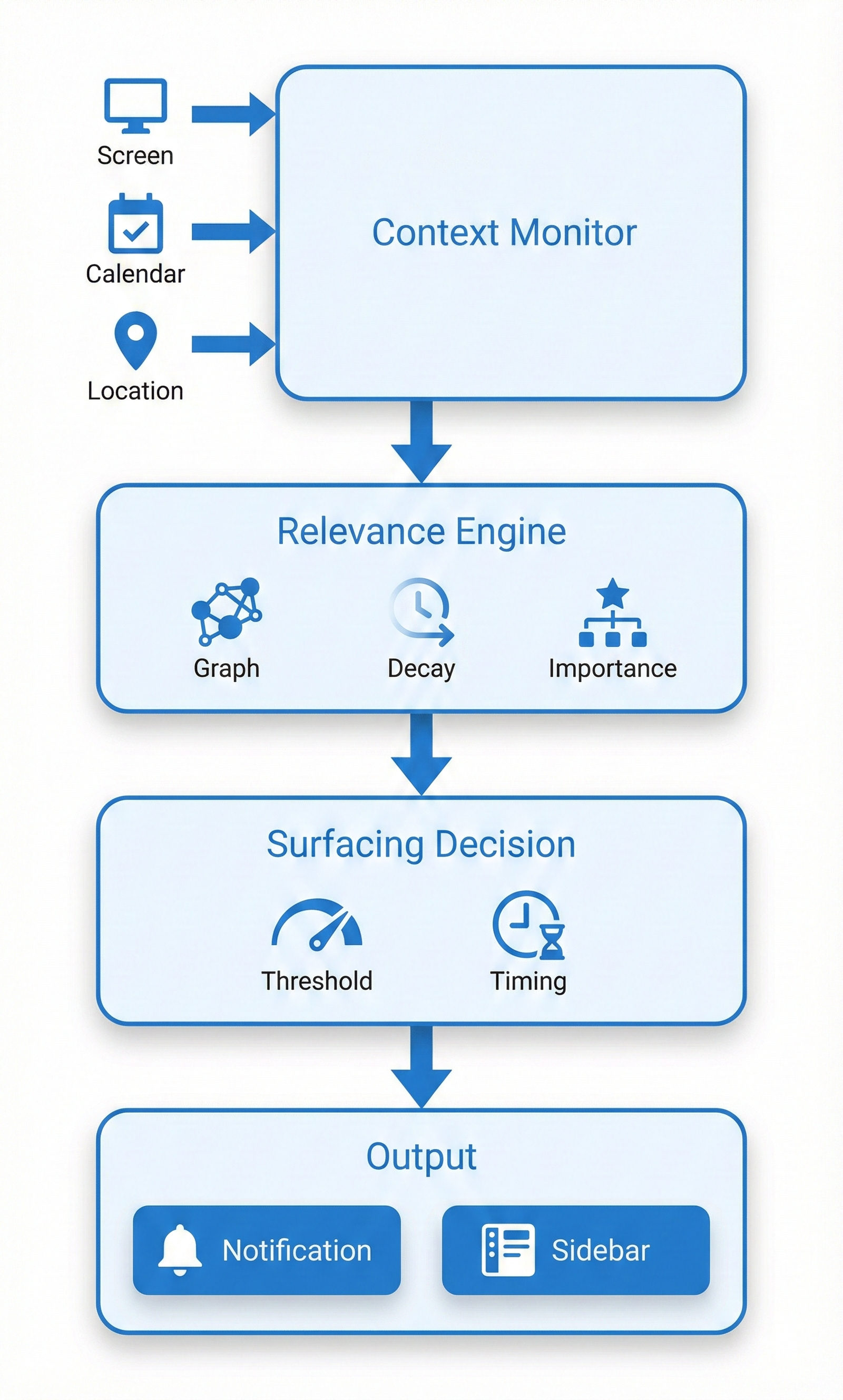
9. Measuring Proactive Value
| Metric | What It Measures |
|---|---|
| Surfacing precision | % of surfaced items user found useful |
| Information discovery | Items surfaced user didn't search for |
| Time saved | Avoided searches due to proactive surfacing |
| Commitment tracking | Reminders that prevented missed items |
| Dismissal rate | Items surfaced but ignored (too aggressive?) |
10. The Shift in AI Interaction
Generation 1: Keyword search
Generation 2: Natural language query
Generation 3: Proactive surfacing
Each generation reduces the burden on the user to know what to ask.
11. Conclusion
Proactive AI is the realization that the best interface is no interface—information appears when relevant.
By combining context monitoring, knowledge graphs, temporal relevance, and on-device privacy, we can build AI assistants that don't just answer questions but anticipate needs.
The goal isn't an AI that responds better. It's an AI that makes asking unnecessary.
Further Reading
- Context-Aware Computing — The foundational research on systems that adapt to context
- Knowledge Graphs — Graph-based knowledge representation
Want to know more about proactive AI? Contact me, I'm always happy to chat!